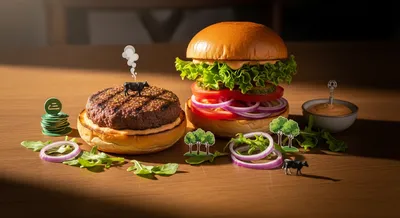
Let's talk about a quarter-pound beef burger. Not as a political statement, not as a guilt trip — just as an object with a measurable environmental footprint that most people have never had reason to look at closely.
Because once you see the numbers, you can't really unsee them. For the broader context on how food choices connect to climate, [the environmental impact of your plate](/article/environmental-impact-of-your-plate) covers the full picture beyond just beef.
Key Takeaway
Producing a single quarter-pound beef burger generates approximately 3.3 kilograms of CO2-equivalent greenhouse gas emissions when accounting for land use, methane from cattle, feed crop production, and processing. Swapping one beef burger per week for a plant-based alternative reduces your annual food-related emissions by a measurable amount.
The Life Cycle of a Burger
Calculating the carbon cost of a beef burger requires looking at the entire system: the land used to grow feed crops, the methane produced by the cattle themselves, the energy used in processing and refrigeration and transportation, and the land conversion that happens when forests or grasslands are cleared for grazing.
A 2023 meta-analysis pooling data from life cycle assessments across multiple countries found the average carbon footprint of a quarter-pound (113 gram) beef burger to be approximately 3.6 kg of CO₂ equivalent (CO₂e). Some analyses put it higher — up to 5 kg depending on farming practices and region.
For perspective: driving a standard passenger car 15 miles produces approximately 6 kg CO₂e. A burger is roughly half a car trip.
But that's not the end of the story.
Where the Emissions Come From
The breakdown is roughly:
- Enteric fermentation (methane from cattle digestion): ~40% of emissions
- Feed production (growing corn and soy to feed cattle): ~30%
- Land use change (deforestation): ~15%
- Manure management: ~10%
- Processing, transport, retail: ~5%
The enteric fermentation number is the one most people don't expect. Cattle produce methane as a byproduct of digestion — it's released when they burp and breathe. Methane is approximately 80 times more potent as a greenhouse gas than CO₂ over a 20-year period (it breaks down faster but is much more powerful while it exists).
The land use number is also significant. Beef production uses about 20 times more land per gram of protein than plant-based protein sources. Much of the deforestation happening in the Amazon is directly driven by demand for cattle grazing land and soy crops grown as cattle feed.
Comparing It to Plant Alternatives
The same quarter-pound of plant-based protein sources:
- Black bean burger patty: ~0.3 kg CO₂e — roughly 12 times lower
- Pea protein-based burger (like Beyond or Impossible): ~0.5-0.8 kg CO₂e
- Lentil-based patty: ~0.25 kg CO₂e
The reduction from swapping a beef burger for a plant-based one isn't marginal. It's roughly an order of magnitude.
The Scale Question
America consumes approximately 50 billion burgers per year. If just 10% of those were replaced with plant-based alternatives, the carbon savings would equal removing approximately 1.5 million cars from the road for a year.
This is not a hypothetical. Consumer behavior at scale has measurable, documented effects on food system emissions. Every percentage point of market shift matters.
What to Do With This Information
I'm not here to tell you never to eat a burger again. I'm here to give you the actual data, which is that the beef burger is one of the highest-impact items in the average Western diet, and the alternatives are both available and good.
Make that trade when it's easy. Choose the [one-pot lentil soup](/article/one-pot-lentil-soup-family-sized), the [black bean tacos](/article/10-minute-black-bean-tacos), the plant-based patty. Not as sacrifice, but as an informed decision.
The arithmetic of climate change is relentless. Every action compounds, and every action is made by someone who decided — or didn't decide — to pay attention.
You're paying attention. That matters. If you're ready to act on it, [your first plant-based week](/article/your-first-plant-based-week) is an honest account of what the transition actually looks like — no highlight reel, just the real experience.